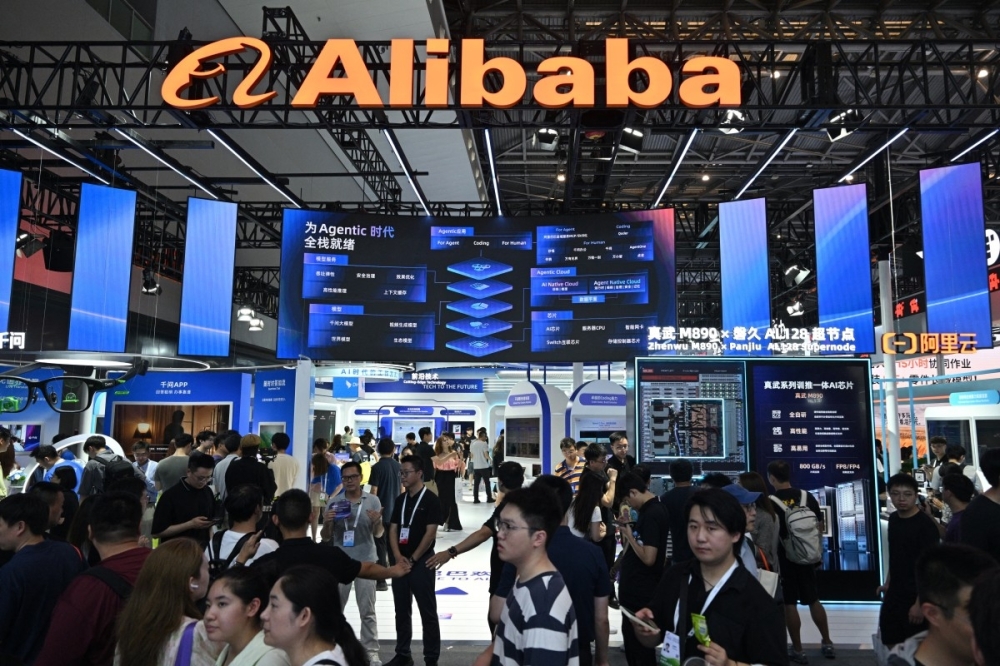





Chinese tech giant Alibaba unveiled plans on Wednesday to expand its overseas data centres, targeting markets across Europe and the Middle East.
Hangzhou-based Alibaba is one of the frontrunners in China's artificial intelligence industry, with its Qwen model among the world's most downloaded AI models.
The company said it would "establish its first cloud regions" in Turkey, Finland and the Netherlands, while "expanding its data centre footprint in Malaysia, Germany, the United Arab Emirates, France and Hong Kong" over the next 12 months.
The announcement came ahead of a highly anticipated meeting between Chinese President Xi Jinping and his US counterpart Donald Trump in Washington, where the two leaders are expected to discuss trade tensions, among other topics.
Beijing and Washington are locked in a tech rivalry increasingly centred on frontier industries including semiconductors, AI and robotics.
Alibaba CEO Eddie Wu said on Tuesday that the company was planning to train an AI model with five to 10 trillion parameters, which would make it several times bigger than the current largest Chinese model.
Alibaba is targeting more than 20 gigawatts of global data centre capacity by 2032, Wu said during the firm's annual flagship conference in Hangzhou.
The company also unveiled a new AI chip at the conference, the Zhenwu V900 -- which it said would deliver three times the performance of its predecessor, Zhenwu M890.
"It's the most powerful AI chip in China today," Wu said.
The Zhenwu M890 is widely believed to be two times more powerful than the chip custom-made for the Chinese market by US pace-setter Nvidia, the H20.
Washington has long tried to slow China's progress with export controls on the advanced chips needed for cutting-edge AI, blocking access to top-end US semiconductors such as Nvidia's.
Beijing's push for technological self-reliance has also encouraged Chinese technology companies to adopt domestic chips as alternatives to foreign products.
Oman Observer is now on the WhatsApp channel. Click here